 Trekking CougarsChoosing & Chasing Mountains
By Snehil Khanna — Trekking Cougars ✓ Trekking Cougars Writer
The Brahmatal Trek is one of those places that gets inside you quietly. No dramatic entry, no single moment where the mountains announce themselves. Just a gradual unfolding over six days — through oak and rhododendron forests, across frozen meadows, past two high-altitude lakes — until you are standing at 12,250 feet with Trishul and Nanda Ghunti so close they feel like walls, not mountains.
In 2007, the Brahmatal Trek was still far quieter than it is today. Off-season movement was rare, operator batches were limited, and the trail could feel unexpectedly dry and exposed. That older version of Brahmatal is important because it explains why this route should still be approached with preparation, respect for the terrain, and a guide who understands the Garhwal trail conditions beyond the brochure copy.
This guide covers everything. The facts, the day-by-day experience, how to reach from Delhi and Chandigarh, what season to go, what nobody tells first-timers, and why this trek is one of the finest winter treks in Uttarakhand. If you read this completely before booking, you will be more prepared than 90 percent of people who do this route.
Brahmatal Trek — Quick Facts
A Field Note from Brahmatal in 2007
In 2007, the Brahmatal Trek was not the popular route it is today. We went in what can be called off-season — not monsoon, but dry, with fewer operators on the trail and almost no other trekkers around. It sounds romantic until you realise what dry season actually means at altitude: the streams that you rely on for water are reduced to trickles or have dried up entirely.
By the second day, we were running low. The small water sources expected along the ascent from Bekaltal toward the Brahmatal campsite were far less than anticipated. We didn’t panic, but we slowed down and started rationing what we had.
That afternoon, we came across a shepherd on the trail. His name was Sushil. He was grazing sheep in the meadow above the treeline, completely unhurried, the way people who live in mountains always seem unhurried while the rest of us are calculating distances and water and weather. We told him our situation. He didn’t hesitate — he pointed us to a small stream about 400 metres off the main trail, barely visible, running quietly in a fold in the terrain. Without Sushil, I genuinely don’t know how that day would have ended. He saved us that afternoon with about thirty seconds of conversation and a pointed finger.
Near that same stream, as we were filling our bottles, we heard a sound in the scrub above us. A bear. A Himalayan black bear, unhurried as Sushil, heading across the slope in the opposite direction. It registered us, paused, and kept moving. We stayed very still until it was gone. Then we filled our bottles and walked back to the trail. That was my introduction to the Brahmatal Trek. I have been back many times since and it has never been that dramatic again — but it has always been worth it.
What the Brahmatal Trek Actually Delivers — Before I Tell You the Itinerary
The Brahmatal Trek is famous as a winter trek. That reputation is accurate and deserved — in December, January and February, when the entire route is under snow and both Bekaltal and Brahmatal lakes are frozen, it is one of the most visually extraordinary experiences available to a non-technical trekker anywhere in the Himalayas. But the Brahmatal Trek in autumn — September and October — is a different and equally compelling experience that gets written about far less.
What makes the Brahmatal Trek consistently excellent across seasons is its structure. Two lakes of completely different character — Bekaltal enclosed by forest, intimate and dark-watered; Brahmatal open and stark, sitting in a mountain amphitheatre at the foot of serious peaks. A ridge walk at Tilandi / Jhandi Top that opens without warning into 180-degree Himalayan views. A summit at 12,250 feet where Trishul stands so close it looks like you could reach the base in an afternoon. And a mythology that gives the whole place a dimension beyond the visual — this is believed to be where Lord Brahma meditated, the Creator God of the Hindu trinity. That weight is real when you are sitting at the lake in the early morning and the mountains are completely silent.
Day-by-Day Itinerary — Brahmatal Trek
Day 1 — Drive to Lohajung (7,600 ft)
The Brahmatal Trek starts from Lohajung, a small village in the Chamoli district of Uttarakhand. From Rishikesh the drive is 250–270 km and takes 10–11 hours via Devprayag, Rudraprayag and Karnaprayag — three of the sacred Prayags (river confluences) of the Garhwal Himalayas. From Kathgodam the distance is approximately 220 km, 7–8 hours. Most operators pick up from Rishikesh or Kathgodam depending on the group.
Arrive at Lohajung by evening. Trek briefing, gear check, hot dinner and sleep. If you reach before sunset, look for Nanda Ghunti — it is directly visible from Lohajung and the evening light on it is one of the better pre-trek views I have seen.
Day 2 — Lohajung to Bekaltal (6 km / 5–6 hours / 9,600 ft)
The Brahmatal Trek begins in earnest. The first section out of Lohajung descends slightly before entering the oak and rhododendron forest. From here it climbs steadily through dense forest — conifer, cedar, oak and fir making a canopy above you for most of the first few kilometres. In winter this forest is snow-covered and hushed. In autumn the oak leaves are turning. In spring the rhododendrons are in bloom and the forest floor is covered in fallen red flowers.
After about 4 km there is a small dhaba at a clearing — the last chance for Maggi and chai before camp. Beyond this the trail continues to Bekaltal Lake at 9,600 feet, surrounded entirely by dense forest. The lake sits in a quiet basin and the trees reflect in the water when it isn’t frozen. In winter it is frozen solid. Bekaltal has a small temple dedicated to Nag Devta on its bank. Camp is set a short walk from the lake.
Day 3 — Bekaltal to Brahmatal / Tilandi Camp (7 km / 5–6 hours / 10,495 ft)
This is the day the Brahmatal Trek reveals itself. The first 90 minutes out of Bekaltal is a steep climb through the upper forest. Then the trees thin, the forest opens, and you step onto Tilandi — a wide, high meadow (Bugyal) with the full Trishul massif directly in front of you. It arrives without announcement. One moment you are in forest, the next you are on an open ridge with Mt. Trishul, Nanda Ghunti, and the full Garhwal range spread out before you like a wall.
The ridge walk from Tilandi to Jhandi Top is the finest section of the Brahmatal Trek. The trail runs along the ridge with valleys dropping away on both sides — villages of Deval and Tharali visible far below, mountain peaks dominating above. At Jhandi Top the Brahmatal lake becomes visible in the valley below. Camp is typically at Tilandi or just below the Brahmatal lake — operators vary on this.
Day 4 — Brahmatal Summit (12,250 ft) and Descent to Lohajung (9 km / 7–8 hours)
Summit day on the Brahmatal Trek starts early — ideally by 5:30 AM to catch sunrise from the top. The ascent from the campsite to Brahmatal Top takes 2.5 to 3 hours. The final section involves a steep climb to two ridges — Chota Jhandidar and Bada Jhandidar — before the summit opens up.
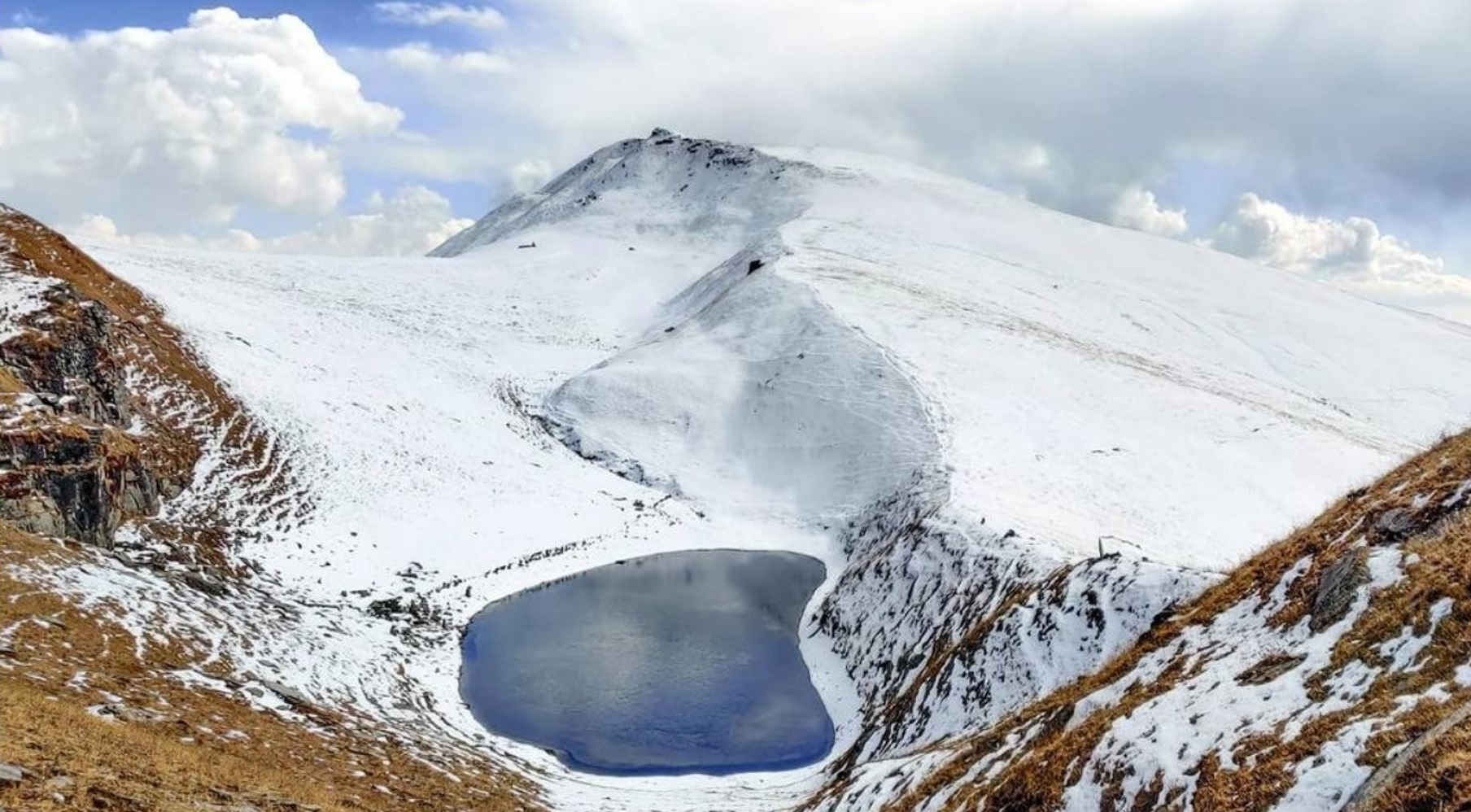
At 12,250 feet, the view from Brahmatal Top is 180 degrees of Himalayan peaks. Trishul and Nanda Ghunti are close — uncomfortably, magnificently close. Behind them, Chaukhamba, Neelkanth, Maitoli, and Hathi-Ghoda peaks. On very clear days you can see the Ali Bugyal and Bedni Bugyal meadows — the Roopkund Trek trail is visible on the opposite ridgeline. The frozen Brahmatal Lake sits below you.
After summit, descent back to Brahmatal campsite, then all the way to Lohajung via Jhandi Top. It’s a long day — 7 to 8 hours total. Worth every minute of it.
Day 5 — Drive Back to Rishikesh / Kathgodam
Start early from Lohajung. The drive back takes 10–11 hours to Rishikesh, 7–8 hours to Kathgodam. Most groups arrive at their drop point by evening.
How to Reach the Brahmatal Trek from Delhi, Chandigarh and Other Cities
The Brahmatal Trek starts from Lohajung in the Chamoli district of Uttarakhand. All routes to the Brahmatal Trek converge on either Rishikesh or Kathgodam, from where you drive to Lohajung.
From Delhi: Two options. Option 1 — take an overnight bus or train to Rishikesh/Haridwar (5–6 hours), then drive from Rishikesh to Lohajung (250–270 km, 10–11 hours). Option 2 — take a train to Kathgodam (Ranikhet Express from Delhi, arrives Kathgodam ~5 AM), then drive Kathgodam to Lohajung (220 km, 7–8 hours). Kathgodam is the faster route. Delhi to Lohajung total: approximately 490 km.
From Chandigarh: Drive or take a bus to Rishikesh (~5 hours) via Haridwar, then drive Rishikesh to Lohajung (10–11 hours). Alternatively, drive to Kathgodam via Roorkee and Rampur (~7 hours from Chandigarh), then Kathgodam to Lohajung (7–8 hours). Chandigarh to Lohajung total: approximately 500 km. Expect a long Day 0 if coming directly.
From Mumbai / Bengaluru / Hyderabad: Fly to Dehradun (Jolly Grant Airport) or Delhi. From Dehradun, Lohajung is approximately 290 km — drive via Rishikesh (9–10 hours).
By Train — Best Option: The Ranikhet Express (Train 15013) from Old Delhi departs at 10:40 PM and arrives Kathgodam at 5:30 AM. Seats fill fast — book 60 days in advance. From Kathgodam hire a taxi or join a shared jeep to Lohajung.
Nearest railway: Kathgodam (220 km from Lohajung) · Nearest airport: Dehradun / Pantnagar · Last ATM: Karnaprayag or Tharali — withdraw cash before leaving main highway · Mobile network: Unreliable from Lohajung onwards — inform family before starting
Best Season for the Brahmatal Trek — Honest Month-by-Month Guide
The Brahmatal Trek has multiple good windows. Each is genuinely different. Here is what I know from having done this trek across seasons.
The Brahmatal Trek at its most iconic. Both lakes frozen. Trail under snow. Rhododendron and oak forests covered in white. Temperatures -5°C to -10°C at night at high camp. Proper winter gear mandatory — this is not a soft trek in December. But the frozen lakes and snowfields are extraordinary. Best for people who want the full winter experience.
Snow still on higher sections. Rhododendrons bloom from March — the forest turns red and pink in a way that photographs can’t fully capture. Lakes start thawing. Pleasant days, cold nights. This is an underrated window for the Brahmatal Trek and one of my personal favourites.
Snow mostly gone. Meadows lush and green. Pleasant weather. Best for first-timers who want to do the Brahmatal Trek without snow. Fewer crowds than winter. The Tilandi meadow in June is stunning. Water sources reliable.
Post-monsoon clarity. The air is washed and the peaks are sharpest in September and October. Fewer trekkers on the trail. The Tilandi ridge walk and summit views are at their finest in this window. My recommendation if you want the views more than the snow.
Trails become slippery, leeches are active in the forest sections, and stream crossings can become unpredictable after heavy rain. The Brahmatal Trek is not recommended in monsoon season. Skip it. Come back in September.
Brahmatal Trek vs Kedarkantha — Which One Should You Do?
This comparison comes up constantly because both are popular Uttarakhand winter treks at similar altitudes. Let me be direct about the differences.
Kedarkantha is more crowded. Brahmatal Trek is quieter, has two lakes, and the ridge walk at Tilandi is a section that Kedarkantha simply does not have an equivalent of. If you have done Kedarkantha and want to do another Uttarakhand winter trek — the Brahmatal Trek is the natural next step. If you haven’t done either and want a first Himalayan winter trek — both work, but Brahmatal Trek gives you more variety per day.
The Spiritual Side of the Brahmatal Trek
This gets mentioned in most trek descriptions and then immediately dropped. I want to stay with it a moment because I think it matters more than most guides acknowledge.
Brahmatal is believed to be the site where Lord Brahma — the Creator in the Hindu trinity — meditated. This is not just tourism mythology — it’s a belief that has shaped how local communities relate to this area for centuries. The shepherds who use these routes, the villages of Deval and Tharali below, the local families who have been grazing their sheep on these meadows for generations — they carry this relationship with the place that is entirely different from what a trekker experiences on a six-day batch.
Bekaltal has a small temple to Nag Devta on its bank. The lake itself has a quality of stillness in the morning that feels earned rather than incidental. I am not a particularly religious person, but I have sat at Brahmatal Lake at sunrise several times and felt something that I cannot fully explain in a trek guide. The size of the mountains helps. The silence helps. The fact that human beings have been coming to this place with intention — not just for views but for something else — for a very long time helps.
The Brahmatal Trek is worth doing for the views alone. It is a more complete experience if you arrive knowing what you are walking into.
What Nobody Tells You Before the Brahmatal Trek
Water on the trail is seasonal. This is the lesson my 2007 trip taught me. In peak winter when the snowpack is generous, water is available as snowmelt throughout the route. In dry conditions — early season, off-season, or drought years — the trail above Bekaltal toward the Brahmatal campsite can have very limited water. Carry 2 litres minimum from each campsite and do not assume streams will be running. Your guide will know which sources are reliable at the time of your trek. Ask them specifically before you leave camp each morning.
Bears live here. Himalayan black bears are present in the Brahmatal Trek forests — I have seen one myself on the trail above Bekaltal. They are not aggressive toward humans by default, but you should know they are there. Make noise in dense forest sections. Don’t leave food unattended at camp. Don’t run if you see one from a distance. Let it know you are present and give it space to move away. This is standard wilderness behaviour and nothing specific to the Brahmatal Trek — bears live in most Himalayan forests above 7,000 feet.
Day 4 is long. The summit day covers 9 km with significant ascent and descent. Most people underestimate the return journey from Brahmatal Top to Lohajung — it feels long after the summit euphoria fades. Trekking poles are not optional on this day. Knee support if you need it. Start as early as the guides say to start.
Snow changes everything in winter. Knee-deep snow on the trail from Tilandi to the summit is common in January. It is not dangerous — it is actually what most people come for — but it slows you significantly. A section that takes 2 hours in autumn can take 3.5 in deep snow. Factor this into your expectations for Day 4.
Lohajung has basics but not much. There are a couple of local shops where you can buy basic gear — hats, gloves, jackets — but don’t rely on them. Come prepared from home. The altitude at Lohajung (7,600 ft) means even the base camp is not trivial. Spend the evening quietly, eat well, sleep early.
Fitness and Preparation for the Brahmatal Trek
The Brahmatal Trek is rated Easy to Moderate, which means it is genuinely accessible to beginners with basic fitness. But “basic fitness” needs defining. If you can walk 8–10 km in a day at a steady pace without stopping frequently, you are ready. If you haven’t walked more than 3 km at a stretch in the last six months, spend 4–6 weeks preparing before you book.
For winter batches specifically: the Brahmatal Trek in snow is physically more demanding than in summer or autumn. Walking on snow requires more muscular effort than walking on clear trail. The cold also affects your energy output. For a December–February Brahmatal Trek, I would recommend at minimum 6 weeks of cardio preparation — daily walking of 5–8 km, stairs, and weekend hikes with a loaded pack.
The fitness benchmark: if you can jog 3 km without stopping and walk 10 km comfortably at a moderate pace, you are ready for the Brahmatal Trek in any season. For official detailed information on trekking in Uttarakhand, refer to the Uttarakhand Tourism official website.
What to Pack for the Brahmatal Trek
+
+
+
+
Is the Brahmatal Trek Safe for Solo Women Trekkers?
Yes. The Brahmatal Trek is one of the safer Himalayan treks for solo women, for several reasons. Lohajung is a small, established village where trekking is normal and accepted. The trail has regular foot traffic during peak season. The forests on the lower sections are not remote enough to be truly isolated. And the campsite setup on guided treks means you are always with a group and a guide.
That said, my recommendation for solo women on the Brahmatal Trek is the same as for any Himalayan trek: go with a registered operator rather than completely solo. The section from Bekaltal to the Brahmatal campsite has sections where the trail is less obvious, and having a guide makes both navigation and the overall experience significantly better. The summit day starts early in darkness — having a guide on that section is not optional.
Solo women trekkers who have done the Brahmatal Trek with Trekking Cougars consistently report it as one of their most positive trekking experiences. Small groups, focused guides, and an itinerary that doesn’t rush.
Frequently Asked Questions — Brahmatal Trek
+
+
+
+
+
+
+
A Last Word on the Brahmatal Trek
I think about Sushil sometimes — the shepherd who pointed us to that small stream in 2007 when we were dry and getting worried. He didn’t make a big deal of it. He just told us where the water was and moved on with his sheep. That interaction stayed with me because it was so simple and so significant at the same time — a person who knew the mountain in a way that we didn’t, being generous with that knowledge without being asked twice.
That is something about the Brahmatal Trek that the itineraries and the altitude numbers don’t capture. The trail runs through places where people live and work — shepherds using the same routes for seasonal migration, villagers whose relationship with the Dhauladhar and Garhwal ranges is not recreational but essential. Trekking through here is a privilege, and the best thing you can do is come with some awareness of that.
The Brahmatal Trek will give you two extraordinary lakes, a ridge walk that stops conversation, a summit with views that put your daily concerns in their correct proportion, and — if you time it right — a frozen landscape that looks like the world has been remade overnight. That is a lot for six days.
Come prepared. Go slowly. Carry enough water. And if you meet a shepherd on the trail who wants to talk, take a few minutes. They know things about this mountain that no guide, including this one, can fully capture.