 Trekking CougarsChoosing & Chasing Mountains
Dehradun to Dehradun / Moderate
Har Ki Dun Trek
Har Ki Dun – the “Valley of Gods” – is one of the most ancient and breathtaking trekking destinations in the Garhwal Himalayas of Uttarakhand. Nestled inside Govind Pashu Vihar National Park at an...


Overview
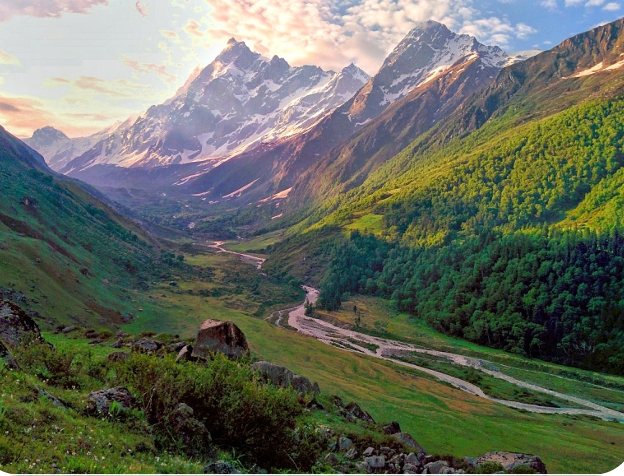
Har Ki Dun – the “Valley of Gods” – is one of the most ancient and breathtaking trekking destinations in the Garhwal Himalayas of Uttarakhand. Nestled inside Govind Pashu Vihar National Park at an altitude of 3,566 metres (11,600 ft), this cradle-shaped hanging valley is famous for its sweeping views of the Swargarohini group of peaks, the Supin River, dense conifer forests, and time-frozen Himalayan villages like Osla and Seema. According to the Mahabharata, the Pandavas passed through this very valley on their way to heaven – giving the trek a rare combination of natural grandeur and mythological significance. Whether you are a first-time trekker or a seasoned mountain lover, Har Ki Dun is the perfect Himalayan experience.
TREK QUICK FACTS BOX
| Detail | Info |
|---|---|
| Trek Name | Har Ki Dun — Valley of Gods |
| Duration | 7 Days / 6 Nights |
| Difficulty | Moderate (Beginner-Friendly) |
| Maximum Altitude | 3,566 m / 11,600 ft |
| Total Trek Distance | Approx. 44 km |
| Base Camp | Sankri, Uttarakhand |
| Best Season | March–June & September–December |
| Starting Point | Dehradun |
| Trek Price | ₹8,000 per person (GST extra) |
| Stay | Camping (Twin Sharing) + Guesthouse |
| Food | All meals during trek included |
TRIP HIGHLIGHTS
1. The Boslow Forest — A Walk Into a Fairy Tale The Boslow Forest, draped in ancient oak, pine, and cedar, is one of the most atmospheric sections of the trail. In early season, snow patches filter through the canopy and light floods through in streaks. Walking through Boslow feels unlike any other forest in the Himalayas.
2. Osla Village — Mythology Comes Alive Osla is one of the most fascinating villages on any Himalayan trek. The 2,000-year-old Someshwar Temple, the wooden homes with their distinctive architecture, and the warm hospitality of locals who still follow ancient traditions make Osla an unmissable cultural stop.
3. The Supin River — Your Constant Companion From Taluka to the valley, the turquoise-green Supin River accompanies you for most of the journey. The sound of the river, the wooden bridges crossing it, and the riverside campsites make this one of the most scenic river-trail combinations in Uttarakhand.
4. Devsu Thatch — The Hidden Meadow Devsu Thatch is a large open meadow above the Thamsa River, largely unknown outside serious trekking circles. Its beautifully undulating grassy mounds create a multi-layered landscape that feels more like a painting than a real place.
5. Har Ki Dun Summit — The Valley of Gods The summit day is the emotional peak of the trek. Surrounded by Swargarohini I–IV, Hata Peak, and Black Peak, the valley opens up in every direction. The silence, the scale, and the sense of standing inside a natural amphitheatre are experiences that stay with trekkers for a lifetime.
6. Morinda Tal (Maninda Lake) — The Bonus Destination Just beyond the Har Ki Dun valley lies Morinda Tal, a glacial lake at 3,925 metres. On a clear day, the lake reflects the surrounding peaks in its still water — one of the most photogenic moments of the entire trek.
Who Can Do the Har Ki Dun Trek?
The Har Ki Dun trek is graded Moderate and is suitable for beginners with a basic level of fitness. You do not need any prior trekking experience.
You are ready for this trek if you can:
- Walk 5 km in under 50 minutes on flat ground
- Climb stairs continuously for 20–25 minutes without stopping
- Exercise regularly (walking, cycling, jogging) for at least 3–4 days a week
Minimum Age: 10 years and above Maximum Age: 65 years (with doctor’s clearance) Group Type: Individuals, families, friend groups, corporate teams
Fitness Preparation (Start 4 weeks before your trek): Begin with 30 minutes of brisk walking daily. Progress to jogging 3–4 km in the third week. Practice stair climbing with a light backpack (5–7 kg) to prepare your knees for descent.
Why Har Ki Dun is Special
The Har Ki Dun trek stands apart from most Himalayan treks for several reasons:
The Valley of Gods The name “Har Ki Dun” translates to “Valley of Shiva” or “Valley of Gods” in the local Garhwali dialect. According to Hindu mythology, the Pandavas chose this valley as their path to Swargarohini — literally “the stairway to heaven.” Trekking here is not just a physical journey; it is a walk through living history.
Ancient Villages Frozen in Time The trail passes through some of the oldest continuously inhabited villages in the Himalayas — Taluka, Seema, and Osla. Wooden houses with intricately carved balconies, centuries-old temples, and villagers in traditional attire make you feel as if time has stood still. In Osla village, the famous Someshwar Temple (dedicated to Lord Shiva) is over 2,000 years old and houses one of the last surviving temples historically dedicated to Duryodhana from the Mahabharata.
Swargarohini and Bandarpoonch Peaks The summit day rewards you with unobstructed views of the Swargarohini I, II, III and IV peaks, Bandarpoonch, Hata Peak, and Kala Nag (Black Peak). The panorama from the Har Ki Dun valley is considered among the finest in the entire Garhwal Himalayan range.
Morinda Tal — A Hidden Gem Beyond the main Har Ki Dun valley lies Morinda Tal (also called Maninda Lake), a stunning high-altitude glacial lake at approximately 3,925 metres. Set against the backdrop of Hata Peak and Swargarohini, this lake is a magical bonus destination on the summit day.
Govind National Park Wildlife The trek route passes through Govind Pashu Vihar National Park, home to rare Himalayan species including the Monal pheasant (Uttarakhand’s state bird), Himalayan Black Bear, and the elusive Snow Leopard. In spring, the trail explodes with wildflowers and blooming rhododendrons.
Detailed Itinerary
Har Ki Dun Trek - Trekking Cougars
Itinerary: Route 1
DAY 1: Dehradun to Sankri: The Gateway to the Himalayas
- Altitude: 1,950 m (6,400 ft) |
- Drive Distance: 220 km |
- Drive Duration: 10 hours
DAY 2: Sankri to Pauni Garaat via Taluka: Discover Himalayan Charm
- Altitude: Taluka: - 2,200 m / 7,200 ft |
- Pauni Garaat: - 2,500 m / 8,200 ft. |
- Sankri to Taluka (Drive): 12 km (1 hour) |
- Trek Distance: 10 km | Trek Duration: 6 hours |
- Features: Scenic spring water stops, packed lunches, riverside camping, and breathtaking Himalayan vistas
DAY 3: Pauni Garaat to Kalkattiyadhar: A Trek Through History and Scenic Landscapes
- Altitude: 3,000 m/ 9,850 ft.|
- Trek Distance: 8 km |
- Trek Duration: 5 - 6 hours |
- Features: Packed lunch, spring water points, historical village visit, and stunning mountain views
DAY 4: Kalkattiyadhar to Har Ki Doon and Back: The Summit Adventure
- Starting Altitude: Kalkattiyadhar (3,000 m / 9,850 ft) |
- Summit Altitude: Har Ki Doon (3,600 m / 11,800 ft) |
- Trek Distance: 10 km |
- Trek Duration: 8- 9 hours |
- Features: Packed lunch, spring water points, enchanting alpine views
- Snow peaks in view: Swargarohini, Hata Peak, Black Peak.
DAY 5: Kalkattiyadhar to Pauni Garaat via Osla: Retracing the Himalayan Charm
- Starting Altitude: Kalkattiyadhar (3,000 m / 9,850 ft) |
- Ending Altitude: Pauni Garaat (2,500 m / 8,200 ft) |
- Trek Distance: 8 km |
- Trek Duration: 5 hours |
- Features: Packed lunch, spring water points, riverside camping, and cultural immersion
DAY 6: Pauni Garaat to Sankri via Taluka: The Final Descent
- Starting Altitude Pauni Garaat (2,500 m / 8,200 ft) |
- Ending Altitude: Sankri (1,950 m / 6,400 ft) | Trek Distance: 10 km
- Trek Duration: 5 hours |
- Drive Distance: 12 km | 1 hours from Taluka to Sankri |
- Features: Packed lunch, spring water points, guesthouse stay
DAY 7: Sankri to Dehradun: Farewell to the Majestic Himalayas
- Drive Distance: 220 km |
- Travel Time: 7:00 AM - 5:00 PM (10 hours) |
- Meals: Breakfast and lunch at route stops |
- Drop-Off Point: Dehradun Prince Chowk |
Inclusions
- Pick-up and drop-off from the designated assembly point in Dehradun
- All meals from the first night’s dinner to the last day’s breakfast (vegetarian)
- Experienced local trek leader and high-altitude camp chef
- Camping accommodation in twin-sharing tents throughout the trek
- Guesthouse/hotel stay where applicable (Sankri)
- All forest permit and national park entry fees
- First aid kit and basic medical support
Exclusions
- Transport to/from Sankri (you arrange your own travel to Dehradun)
- Personal expenses, tips, and phone charges
- Porter/mule service (available at ₹350 per bag per day, 12 kg limit)
- Trek insurance (strongly recommended)
Best Time to Do Har Ki Dun Trek
The Har Ki Dun trek is open almost throughout the year, with each season offering a very different experience.
Spring & Summer (March to June) — Recommended for First-Timers This is the most popular window. Snow from winter is still visible on the peaks, wildflowers cover the meadows, and the Supin River flows at its most scenic. Temperatures range from 5°C to 18°C during the day.
Autumn (September to November) — Crystal Clear Views Post-monsoon skies are the clearest of the year. Peak views of Swargarohini, Bandarpoonch, and Kala Nag are sharpest in this window. The forests turn amber and gold, making it exceptionally photogenic.
Winter (December to February) — Snow Trek Adventure For experienced trekkers seeking a snow trekking experience, the winter Har Ki Dun trek is unforgettable. The trail is covered in deep snow, temperatures drop to -10°C at night, and the valley becomes a pristine white wonderland. This season requires extra gear and preparation.
Monsoon (July to August) — Not Recommended The trail becomes slippery and landslide-prone. This window is best avoided unless you are an experienced monsoon trekker.
Other Details
Frequently Asked Questions
Q1. Is Har Ki Dun trek suitable for beginners?
Yes. Har Ki Dun is one of the most beginner-friendly moderate treks in the Himalayas. Daily walking distances range from 8–12 km, and no technical climbing is required. A basic fitness level — being able to walk 5 km comfortably — is sufficient.
Q2. What is the best time to do the Har Ki Dun trek?
The best time is April to June for pleasant weather and spring blooms, and September to November for crystal-clear mountain views. December to February is ideal for snow trekking.
Q3. How do I reach Sankri (the trek base camp)?
Take an overnight bus or train from Delhi to Dehradun (approximately 6 hours). From Dehradun, shared jeeps and private cabs are available to Sankri (approximately 10 hours drive, 220 km). Trekking Cougars can assist with transport arrangements — call us at +91 81988 38368.
Q4. What should I pack for the Har Ki Dun trek?
Essential items include layered warm clothing, a waterproof jacket, trekking shoes (ankle support), sunscreen, sunglasses, a personal water bottle (2 litres), a headlamp, basic medicines, and energy snacks. A detailed packing list is shared with all confirmed trekkers.
Q5. Is Har Ki Dun safe for solo trekkers?
Yes, solo trekking on Har Ki Dun is safe when done with a registered group and guide. Trekking Cougars operates fixed-departure group batches throughout the season, so solo travellers can join a group and trek safely.
Q6. What is Morinda Tal and can we visit it from Har Ki Dun?
Morinda Tal (also called Maninda Lake) is a glacial lake at 3,925 metres, located approximately 45 minutes beyond the main Har Ki Dun valley. On a clear day, it offers stunning reflections of Hata Peak and Swargarohini. Trekking Cougars includes a visit to Morinda Tal on the summit day for suitable groups.
Q7. What is the total distance of the Har Ki Dun trek?
The total trekking distance is approximately 44 km over 7 days. Daily distances range between 8 and 12 km, with 5–8 hours of walking each day.
Q8. Is the food provided on the trek vegetarian?
Yes, all meals provided by Trekking Cougars are freshly cooked vegetarian meals. Eggs are available on request at most campsites.
Cancellation Policy
- Cancellation due to weather, road blocks, government restrictions, or natural conditions is handled case by case by the team.
- Client cancellations are reviewed against the confirmed booking date and payment status.
- Payment link is shared only after availability, group size, inclusions, GST, and final price are confirmed.