 Trekking CougarsChoosing & Chasing Mountains
By Shivam Nair — Trekking Cougars ✓ Verified Guide | Last on this trail: August 2024
Duration
Max Altitude
Total Distance
Best Season
Table of Contents
ToggleWhat is the Valley of Flowers Trek?
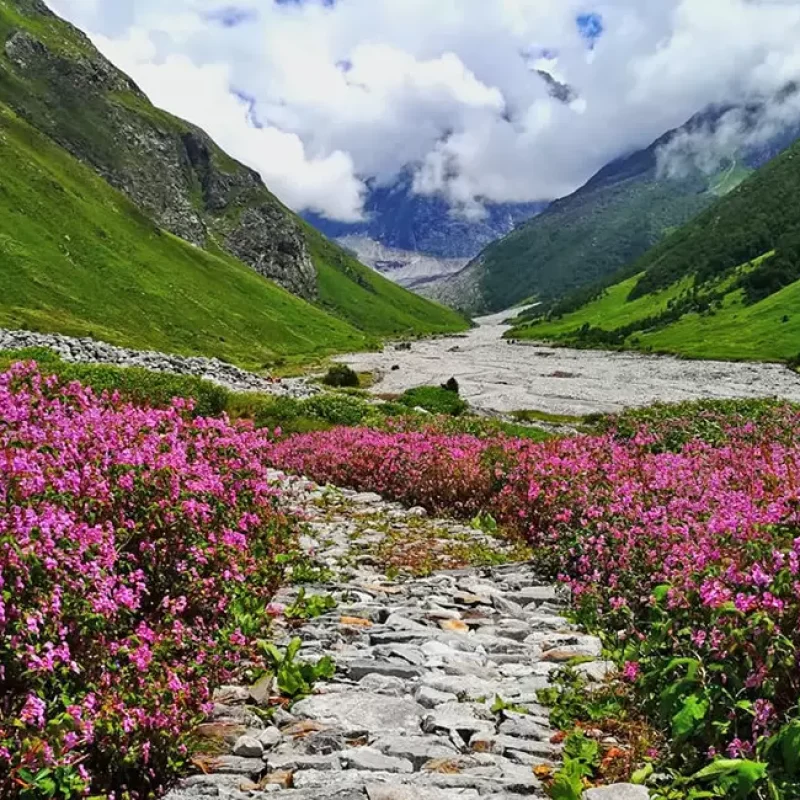
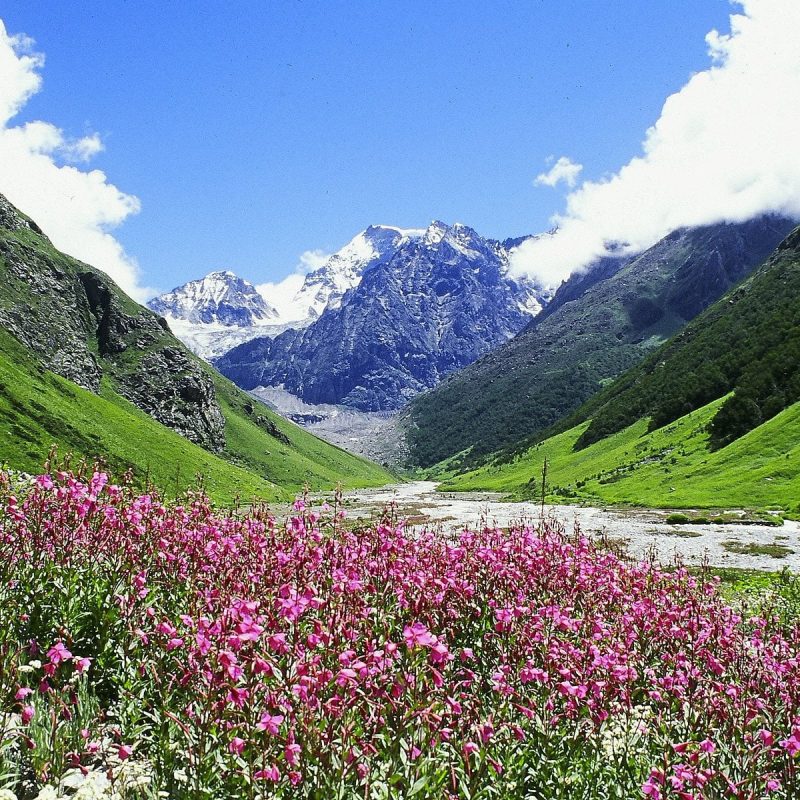
There’s a version of this story I’ve told at least thirty times around campfires, and I still haven’t found a shorter way to say it. You wake up at Ghangaria. It’s 6:45 AM. You pull on damp socks and eat whatever’s available — usually bread and something sweet. You start walking. The trail goes into forest. Then the trees stop. And then the valley is just there.
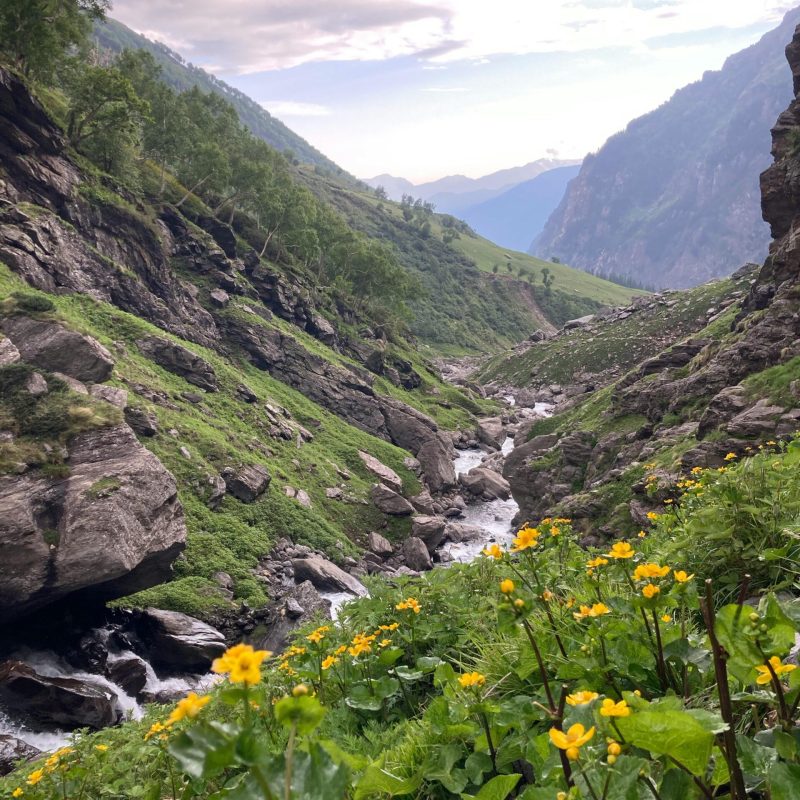
Not dramatic. Not sudden. Just — there. Wall to wall colour. Blue poppies, cobra lilies, Brahma Kamal, a hundred yellows and purples you don’t have names for. The Pushpawati River cutting through the middle of it. Mountains going up on every side. And you just stand there like an idiot, phone half-raised, forgetting to take the photo.
The Valley of Flowers National Park sits in the Chamoli district of Uttarakhand, inside the Nanda Devi Biosphere Reserve — a UNESCO World Heritage Site since 2005. It spans 87 square kilometres of high-altitude meadow at 3,352 to 3,658 metres, home to over 500 species of Himalayan wildflowers that bloom only during the monsoon months. Frank Smythe, the British mountaineer, stumbled into it in 1931 while lost on a descent and named it. The name was right.
The trek combines the valley with Hemkund Sahib — the world’s highest Gurudwara at 14,107 ft, perched beside a glacial lake ringed by seven snow peaks. For Sikh trekkers especially, this is one of the most meaningful journeys in the country. For everyone else, it’s still extraordinary. This guide covers everything you need to plan it properly — written for trekkers coming from Ludhiana, Chandigarh, Amritsar and Delhi.
Trek at a Glance
Why Valley of Flowers is Different from Every Other Trek in India
Most Himalayan treks reward altitude. Summit views, ridgeline panoramas, that one lake at the top. The Valley of Flowers is the only trek in India where the floor is the destination. The valley itself — at 11,000 feet — is where everything happens. And it only exists for three months a year. Here is what makes it genuinely unlike anything else on the subcontinent:
- 500+ species of wildflowers — several endemic to this valley alone and found nowhere else on earth. Protected under Indian wildlife law.
- The monsoon is the season, not the problem — every other Himalayan trek shuts down in rain. This one depends on it.
- Two experiences in one trip — valley visit plus Hemkund Sahib (14,107 ft), the world’s highest Gurudwara, in the same trek.
- Guesthouse-based — no camping, no sleeping bags, no tent logistics. One of the very few Himalayan treks where you sleep indoors every night.
- A UNESCO site you physically walk inside — not viewed from a distance. You spend hours inside the protected ecosystem itself.
Best Time to Do the Valley of Flowers Trek
Target July 25 – August 15 for peak bloom. The Brahma Kamal — Uttarakhand’s state flower and the valley’s most iconic bloom — appears only in August. These two weeks are the best the valley gets all season.
Full bloom. Most species flowering simultaneously. Vivid colours wall to wall. Busiest month — book early.
Brahma Kamal in bloom. Stable monsoon pattern. School holidays. Best window for first-timers from Punjab.
Fewer crowds. Trails drier. Many species fading. Still beautiful but not the full valley experience.
Park closes around Oct 31. Heavy snow from November. Expected to reopen around June 1, 2026 (official date not yet announced).
How to Reach Valley of Flowers from North India
The base for this trek is Govindghat in Chamoli district — roughly 300 km from Haridwar. From there, a 4 km drive takes you to Pulna, where the actual trek begins. Here are your three main options from Punjab and Delhi.
- Overnight train from Ludhiana / Amritsar to Haridwar Station (Jan Shatabdi, Dehradun Express, Amritsar-Haridwar Express)
- Shared Sumo or Bolero from Haridwar to Govindghat — 280 km, 10–11 hours via Rishikesh, Devprayag, Joshimath
- Stop overnight at Govindghat or Joshimath for rest
- 4 km drive or walk from Govindghat to Pulna, then trek begins
Approx cost: ₹1,500–2,200 per person (train + shared cab)
- Chandigarh to Rishikesh: ~230 km, 5 hours. Delhi to Rishikesh: ~240 km, 5–6 hours.
- Rishikesh to Govindghat: ~255 km, 8–9 hours via Devprayag and Joshimath
- Break overnight at Joshimath recommended — avoids mountain driving in dark and helps acclimatisation
Best for groups of 4–6 sharing a vehicle — fuel + tolls ≈ ₹4,000–6,000 total
- Fly to Jolly Grant Airport, Dehradun — direct flights from Delhi, Mumbai, Bangalore
- Jolly Grant to Govindghat: ~290 km, 9–10 hours by cab
- For Punjab trekkers, train to Haridwar is cheaper and often faster than flying to Dehradun
Flight from Delhi ₹2,800–5,000 + cab ₹600–1,200 per person (shared)
1. Carry ₹5,000–8,000 in cash. No ATM in Ghangaria. Joshimath ATMs run dry in peak season — withdraw from Haridwar or Rishikesh.
2. Download offline maps. No mobile data inside the national park. Google Maps offline or Maps.me before you leave.
Altitude Profile — Day by Day
Camp / Key Point
Day-wise Itinerary — Valley of Flowers Trek 2026
Tap any day to expand. Day 1 is open by default.
1
The drive from Haridwar to Govindghat is one of the great Himalayan road journeys. You pass through five river confluences — the Prayags — each one a different shade of grey-green Himalayan water meeting between canyon walls. Lunch stop at Joshimath. Arrive Govindghat by evening.
Tonight: Eat well, drink 3 litres of water, sleep early. The altitude jump from the plains is real even at 6,300 ft — your body needs this night to adjust.
2
Short drive from Govindghat to Pulna, then the trail begins. The path follows the Lakshman Ganga river through dense Himalayan forest — pine, oak, rhododendron. Plenty of waterfalls. The climb is steady, not brutal. Ghangaria (also written Ghangria) is the last inhabited settlement and your home for the next three nights.
Watch out for: This is your first real altitude gain. Slow your pace. If you arrive with a headache, rest immediately and drink water — do not push on. Ghangaria at 9,843 ft is where AMS most commonly appears for plains-dwellers.
3
Start by 7 AM. The entry checkpoint opens at 7 AM and the last entry is at 2 PM — all visitors must exit the park by 5 PM. The 4 km trail from Ghangaria passes through forest before the valley opens in front of you. Spend 2–3 hours inside — there is no right way to do it. Walk, sit, photograph, or just stand there.
Entry fee: ₹200 per person for Indians/SAARC (carry cash + government ID). No plucking of flowers — forest guards are present. Return to Ghangaria by 4 PM at the latest.
4
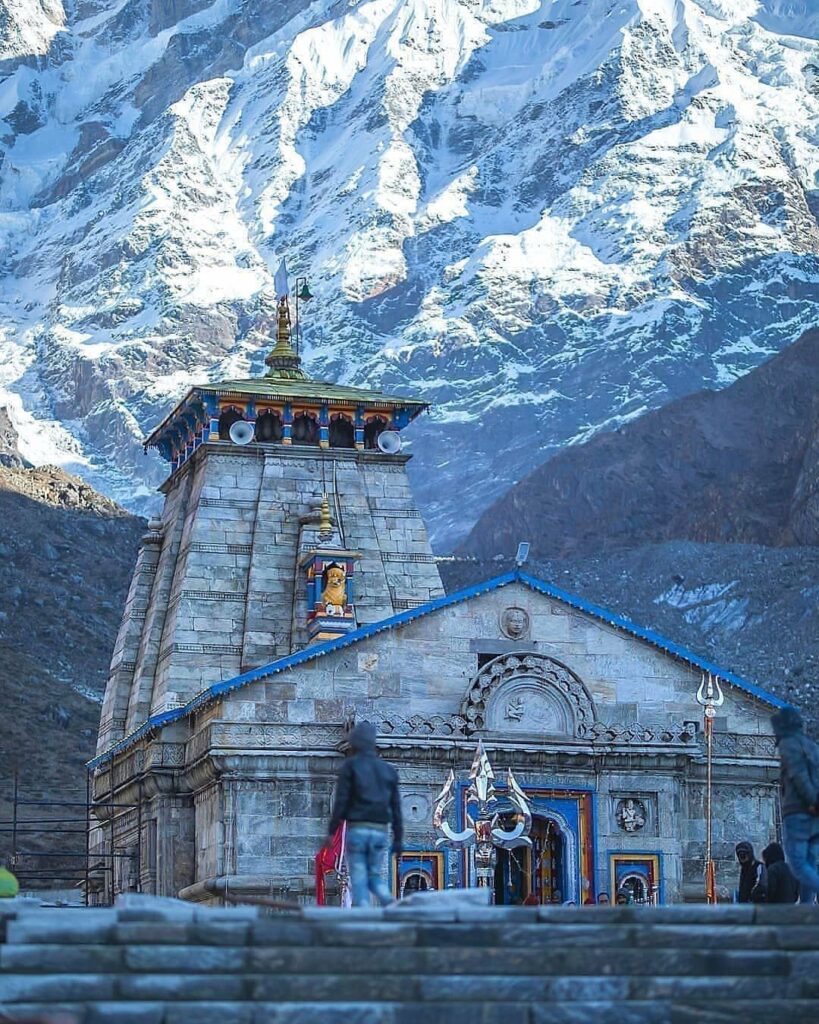
The hardest day and for many, the most moving. Start by 5:30–6 AM. The climb gains over 4,000 feet in 6 km — steep, relentless, and magnificent. At the top sits Hemkund Sahib, the world’s highest Gurudwara, beside a glacial lake encircled by seven snow peaks. The Gurudwara provides free langar — the only free meal on this trek.
If you had headaches on Day 2–3, skip Hemkund. The valley was the main event — Hemkund is a bonus that demands altitude readiness. Ponies and doli available at Ghangaria if needed (₹1,000–2,000).
5
Descent back to Govindghat. Easier than going up but knees need attention on the steep sections — poles are very useful today. Most trekkers are quiet on this walk down. Not from exhaustion. From not quite being ready for it to be over.
Drive to Joshimath or Pipalkoti for the night. Optional extension: Badrinath temple (25 km) and Mana village — the last Indian village before the Tibetan border. Worth it if you have the time.
6
Early departure to reach Haridwar by evening for onward trains home. If time permits, the Ganga Aarti at Har Ki Pauri in Haridwar is the right way to close a trek like this — fire, river, bells, and a crowd that believes in something. Book train tickets home in advance.
Difficulty & Fitness Preparation
Official rating: Easy to Moderate. Honest version: The valley section is genuinely manageable for most adults with basic fitness. Hemkund Sahib on Day 4 is a different matter — a 4,000 ft gain in a single day at altitude is demanding regardless of your fitness level.
- No technical sections, no passes, no river crossings
- Trail is well-marked throughout — this is a pilgrim route, not a wilderness path
- Hemkund Sahib Day 4 requires sustained uphill for 4–5 hours without break
- No camping — guesthouses every night means no gear weight beyond a daypack
| Week | Training Activity |
|---|---|
| Week 1–2 | 5 km daily walk, 20 min stair climbing daily |
| Week 3–4 | Incline walking 30 min daily + weekend 8–10 km hike |
| Week 5–6 | 10–12 km walks with 5 kg daypack — complete without stopping |
You have an active heart condition or breathing issues at rest · You cannot walk 8 km continuously on flat ground · You are pregnant · You’ve had recent surgery in the last 3 months
Real Cost Breakdown 2026 — No Hidden Surprises
| Cost Head | Budget | Mid-Range |
|---|---|---|
| Train Ludhiana → Haridwar (sleeper) | ₹300–450 | ₹700–900 (3AC) |
| Shared taxi Haridwar → Govindghat | ₹1,200–1,500 | ₹2,000–2,500 (private share) |
| Trek package (guide, meals, guesthouse) | ₹7,500–9,500 | ₹12,000–15,000 |
| Valley of Flowers entry permit | ₹200 | ₹200 |
| Porter / pony (optional) | — | ₹1,000–2,000/day |
| Miscellaneous (food, tips, snacks) | ₹500–800 | ₹1,000–1,500 |
| Return journey (same route) | ₹1,500–2,000 | ₹2,500–3,500 |
| Total per person from Ludhiana | ₹11,200–14,450 | ₹18,400–23,600 |
Certified local guide, all meals from Day 1 dinner to Day 6 breakfast, guesthouse accommodation (quad sharing), forest entry permits, pulse oximeter checks, first aid kit. Does NOT include train / flight tickets, personal gear, pony or porter, tips, or emergency evacuation insurance.
Permits for Valley of Flowers Trek 2026
Valley of Flowers vs Kashmir Great Lakes — Which One is Right for You?
| Factor | Valley of Flowers | Kashmir Great Lakes |
|---|---|---|
| Difficulty | Easy–Moderate | Moderate–Difficult |
| Duration | 6 days | 8 days |
| Stay type | Guesthouses (indoors) | Camping |
| First-timer friendly | ✅ Yes | ⚠️ Prior trek needed |
| Highlight | 500+ wildflowers + Hemkund Sahib | 7 glacial lakes + 3 passes |
| Choose this if | First Himalayan trek, families, monsoon lovers | You want raw wilderness and multi-day camping |
Common Mistakes First-Timers Make
Checkpoint closes at 2 PM sharp. No exceptions. Start from Ghangaria by 7 AM or you miss the valley.
Cotton absorbs water and stays wet. At 9,000 ft in monsoon, this causes dangerous chill. Quick-dry synthetics only.
No ATM in Ghangaria. Joshimath ATMs run dry in peak season. Withdraw ₹5,000–8,000 in Haridwar.
Headache at altitude is AMS. If it appears at Ghangaria, skip Hemkund. The valley is the main event anyway.
UNESCO protected. Forest guards present. Heavy fine. Don’t touch, don’t pluck — photograph only.
July–August fills 6–8 weeks ahead. If you’re reading this in May or June, book now — not next week.
What Happens If Weather Turns Bad
- Light rain / mist: Carry on. Monsoon mist often makes the valley more dramatic, not less. Rain jacket on, poles out.
- Heavy rain / slippery trail: Slow down significantly. Stay on the main trail. Follow guide’s judgment on whether to hold or continue.
- Cloudbursts / landslide warning: Halt and shelter immediately. Do not push independently. The Govindghat–Ghangaria trail is landslide-prone in peak monsoon.
- Park closure by Forest Dept: Happens without notice in extreme weather. Trekking Cougars reschedules affected batches at no additional cost where possible. Travel insurance strongly recommended.
Emergency & Safety Contacts
Pulse oximeter check at Ghangaria on arrival (Day 2) and before Hemkund (Day 4). Any trekker with SpO2 below 88% descends — no debate. WFR-certified guide on all batches. Group first aid kit with Diamox, ORS, and oxygen available.
Frequently Asked Questions
+
+
+
+
+
+
+
+
Ready to Book Your Valley of Flowers Trek?
The Valley of Flowers only exists for three months. That is the whole point. You cannot visit on your own schedule — the mountain decides when it blooms and when it closes. That constraint is what makes it matter.
At Trekking Cougars we have been doing this since 2010. We know which guesthouse in Ghangaria has reliable hot water. We know which part of the trail gets slippery after afternoon rain. We have never had a trekker airlifted for a preventable reason. If you want to do this trek properly — not just show up and hope for the best — call Javed directly.